Skincare actives
Tretinoin before and after
Realistic week-by-week progress photos, what actually changes on your skin, and how long it takes before you stop hating the mirror.
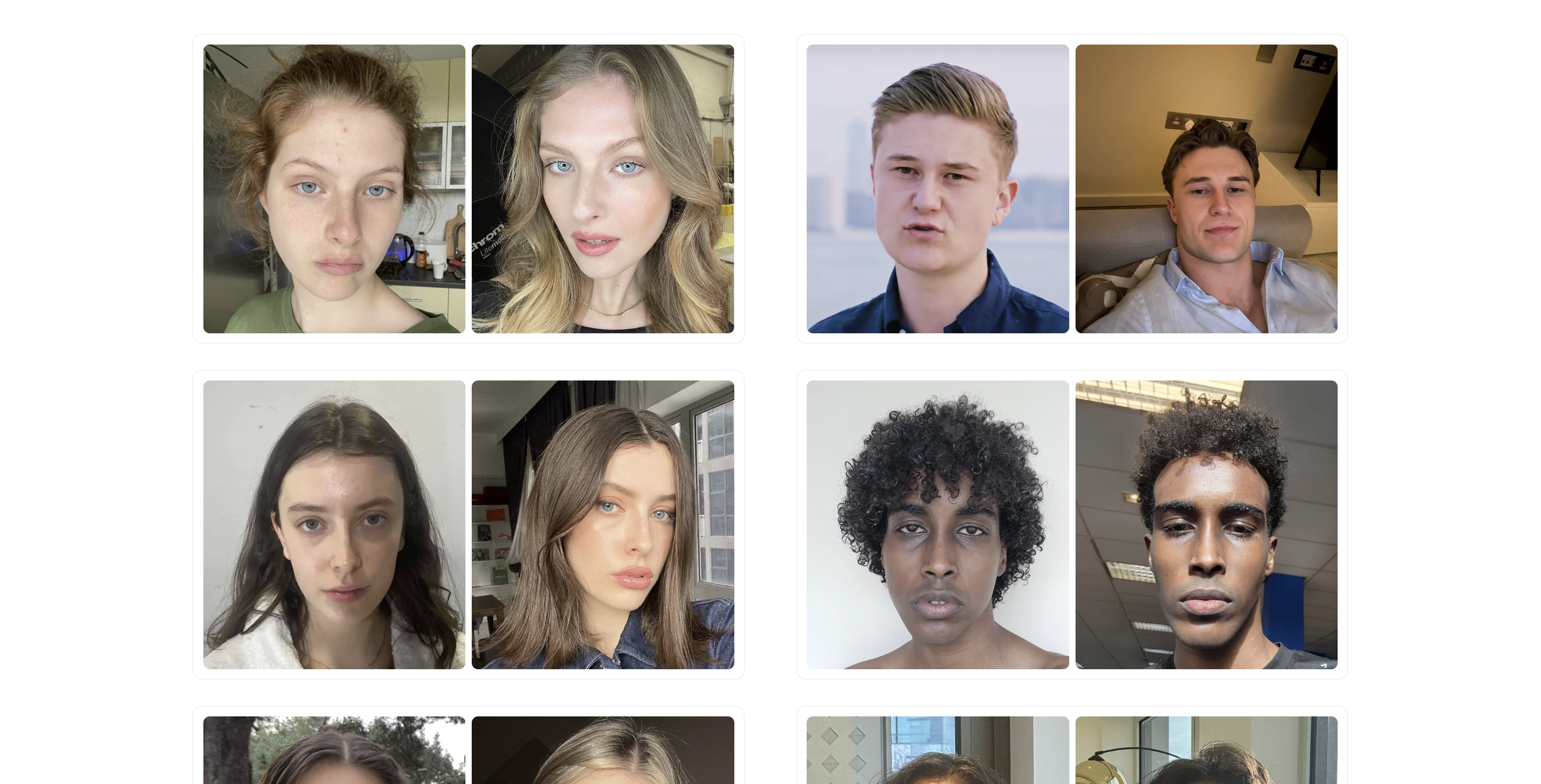
Before: Day 0 — fine lines, uneven texture, post-inflammatory marks
After: 6 months — smoother texture, less pigmentation, brighter skin
- Time to visible results
- 8–12 weeks
- Texture & tone
- Peak benefit
- 6–12 months
- Wrinkle depth & pigment
- Typical starting strength
- 0.025%
- Cream or gel
- Cost
- $15–$80/mo
- Generic Rx
Tretinoin (all-trans retinoic acid) is the only topical FDA-approved to reverse photo-aging, and it's the active behind almost every dermatologist's anti-aging answer. The catch: it gets worse before it gets better. Weeks 2–6 are typically the ugly part — flaking, redness, breakouts — and most people who quit, quit there. The reward, once your skin adjusts, is documented in dozens of RCTs: thicker dermis, smoother surface, faded sun damage, and a measurable reduction in fine lines.
Updated 2026-05-15
What tretinoin actually does to skin
Tretinoin binds to retinoic-acid receptors inside skin cells and tells them, in effect, to act young again. That means faster cell turnover at the surface (which evens out texture and pushes out pigmented cells), and a slow rebuild of collagen and elastin in the dermis below.
- Accelerates cell turnover from ~40 days to ~14 days
- Increases dermal collagen by ~80% over 12 months in RCTs
- Fades post-inflammatory hyperpigmentation and sun spots
- Reduces fine wrinkles and crepiness on cheeks and around eyes
- Shrinks the appearance of pores by thickening the surrounding skin
The realistic timeline
Most people expect results in two weeks. Most people get worse in two weeks. Here's what's actually normal at each stage — and what's not. If your face is genuinely raw, weeping, or your eyes are swelling, that's not the 'retinoid uglies', that's irritant dermatitis. Step down to alternate nights or a lower strength.
How to start without destroying your skin
The single biggest predictor of whether you'll stick with tretinoin is how you onboard. Going nightly on 0.05% from day one is how most people end up with a peeling face and a tube in the bin.
- Start at 0.025% — not 0.05% or 0.1%
- Apply two nights per week for the first three weeks
- Use a pea-sized amount for the whole face
- Wait 20 minutes after washing — apply to dry skin
- Buffer with a moisturiser sandwich (moisturise, wait, retinoid, moisturise)
- Daily SPF 30+ is non-negotiable — tretinoin makes you photosensitive
When tretinoin isn't enough
Tretinoin is excellent for surface tone, fine lines, and pigment — but it can't address deeper structural concerns. If you're after dramatic resurfacing, scar revision, or a fixed contour change, in-office procedures cover ground topicals can't.
Week-by-week
- Day 0
Baseline: existing texture, fine lines, sun damage, post-inflammatory marks.
 Weeks 2–6
The 'retinization' phase. Flaking around the nose and chin, mild redness, sometimes an initial breakout. Skin can look worse than baseline.
 Weeks 8–12
Texture starts smoothing, surface tone evens. Most people stop having visible flaking; makeup applies cleaner.
- 6 months
Visible fading of sun spots and PIH. Fine lines around eyes and forehead look softer. Skin looks 'lit from within'.
 12 months
Peak collagen remodelling in RCTs. Wrinkle depth measurably reduced. Skin thicker on biopsy.
Reference gallery
Frequently asked
How long until I see results from tretinoin?
Most people see texture and tone improvements between weeks 8 and 12. Pigment fading typically follows at 3–5 months. Wrinkle reduction and the dermal collagen rebuild peak between 6 and 12 months. The first 4–6 weeks are the 'retinization' phase where skin can look worse, not better.
What strength of tretinoin should I start with?
0.025% cream or gel for almost everyone. Going straight to 0.05% or 0.1% is the single most common reason people quit. Many dermatologists keep patients on 0.025% indefinitely — there's surprisingly little benefit to climbing higher, and a lot more irritation.
Can I use tretinoin under my eyes?
Yes, carefully. Apply a thin layer of moisturiser first, then a tiny amount of tretinoin tapped (not rubbed) into the orbital bone — not the lid itself. Most fine-line improvement around the eyes comes from this technique combined with daily SPF.
Will tretinoin make me look younger?
It will make your skin function younger — measurably. RCTs show ~80% collagen increase, thicker dermis, reduced wrinkle depth, and faded pigment over 6–12 months. That reads as 'glowy' and 'rested' to most people, not 'I had work done'. For structural changes (lifted jowls, hooded eyes), tretinoin can't help — those need procedures.
Is the 'retinoid purge' real?
Sort of. Tretinoin accelerates turnover, so microcomedones that were already forming can come to the surface faster in weeks 2–6. That's a real, transient breakout — different from tretinoin causing new acne. It typically resolves by week 8.
Do I have to use tretinoin forever?
If you stop, your skin reverts to its untreated trajectory over the following months — collagen synthesis drops back to baseline and texture changes reverse. Long-term use is well-tolerated and remains the gold-standard topical anti-aging treatment.